
An Undercover ETF Yielding 4%
"Perfect ETF Suitable For Retirees"

As you know by my name, I love dividends. And in addition to sharing on here, I write regularly on the investment platform- Seeking Alpha.
My goal there is to teach everyday investors about building wealth, so they won’t to need to work to traditional retirement age.
I want to help you take control of your life, have F.I.R.E.
Here at Dividend Collection Agency the goal is to give investors and/or readers a different perspective. We take a simple approach to building wealth. And although investing may seem easy, people often miss opportunities by over complicating it.
But we are here to help.
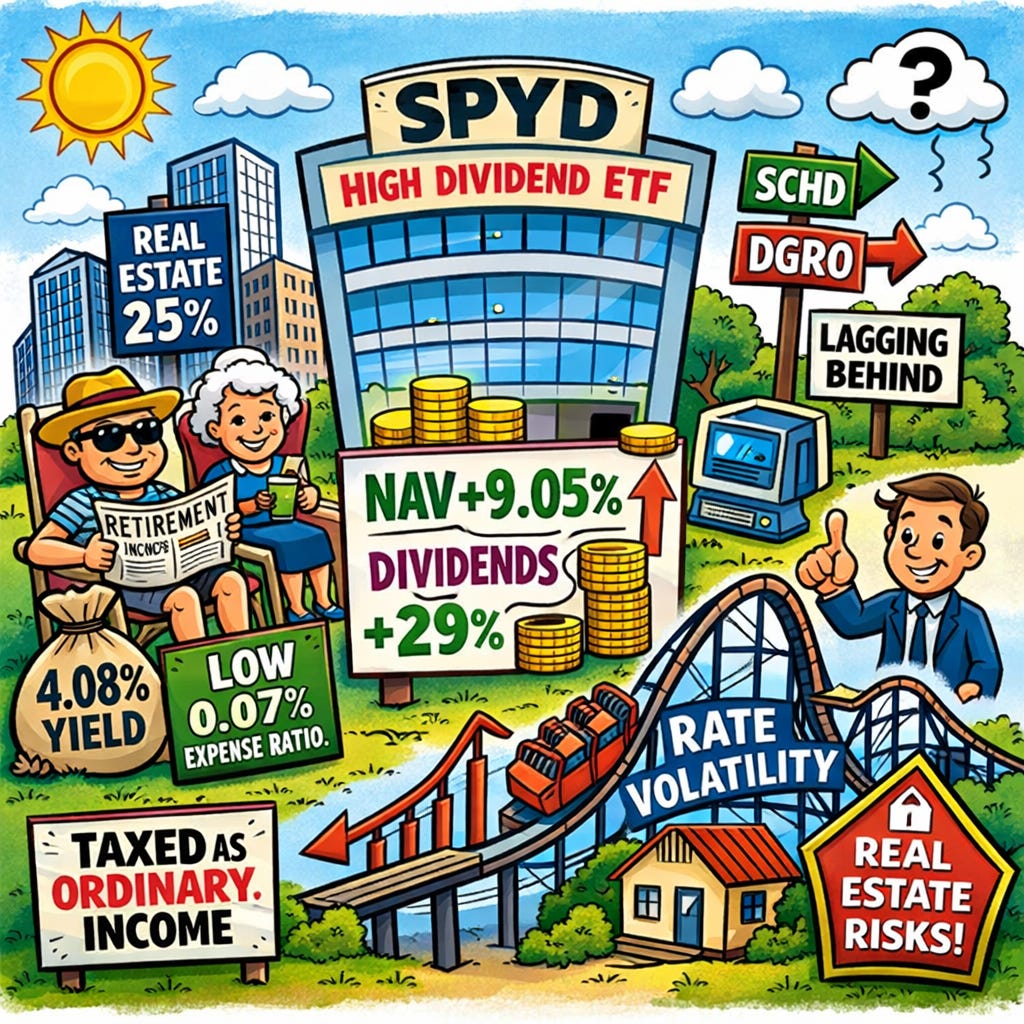
Current Price: $46.14
Yield: 4.08%
Portfolio Purpose: Growth 📉
In recent years, I’ve become increasingly comfortable owning ETFs as part of a diversified portfolio. As someone who once scoffed at the idea, ETFs have grown on me.
While they may lack the excitement of individual stock picking, many ETFs have performed extremely well relative to the broader market. They can serve as core portfolio holdings while allowing investors to build individual positions around them.
For income-focused investors, one ETF worth considering is the State Street SPDR Portfolio S&P 500 High Dividend ETF (SPYD).
In this article, I break down SPYD’s portfolio, historical performance, and why I’m initiating a Buy rating on the fund.
What Is SPYD ⍰
SPYD was launched on October 21, 2015 by State Street (STT), the same firm that created the first U.S. ETF — the SPDR S&P 500 ETF Trust (SPY) — in 1993.
The ETF is designed to track the 80 highest-yielding stocks within the S&P 500.
One of the most attractive features of SPYD is its low-cost structure.
The fund has an expense ratio of just 0.07%, making it competitive with other popular dividend ETFs like:
Schwab U.S. Dividend Equity ETF (SCHD) – 0.06%
iShares Core Dividend Growth ETF (DGRO) – 0.08%
These fees are extremely reasonable for passively managed funds.
For SPYD, investors pay roughly $7 annually for every $10,000 invested.
Where SPYD stands out is yield.
SPYD: ~4.1% yield
SCHD: ~3.3% yield
DGRO: ~2.0% yield
The higher yield comes from SPYD’s focus on higher-dividend companies, which naturally results in lower exposure to growth sectors like technology.
This means SPYD should primarily be viewed as an income vehicle with modest capital appreciation potential.
Historical Performance 📚
While SPYD has delivered solid returns since inception, it has lagged the broader market in recent years.
Over the past five years, SPYD returned roughly 60%, compared to about 89% for the S&P 500 ETF (VOO).
The past three years have shown a similar trend, largely due to the massive outperformance of large-cap technology stocks during the AI boom.
However, performance has begun to shift recently.
Over the past six months, SPYD has actually outperformed VOO, as investors rotate from growth stocks into value and dividend payers.
If this rotation continues — particularly amid rising AI concerns in the software sector — SPYD could continue to see near-term outperformance.
Portfolio & Top Holdings 🎩
SPYD holds 80 high-yielding S&P 500 companies, many of which are well-known income names.
Some of the fund’s top holdings include:
Verizon (VZ)
AT&T (T)
Iron Mountain (IRM)
ONEOK (OKE)
CVS Health (CVS)
Ford Motor Company (F)
One notable characteristic of the ETF is its sector composition.
The fund has heavy exposure to Real Estate (XLRE), which accounts for over 25% of the portfolio.
The next largest sectors include:
Consumer Staples (XLY)
Financials (XLF)
Meanwhile, the Technology (XLK) sector represents only about 2.3% of the portfolio.
This is a key reason why SPYD has historically lagged other dividend ETFs that hold large technology companies.
But again, investors should remember the fund’s objective: income generation.
Interest Rate Sensitivity ↕️
Because of its heavy REIT exposure, SPYD is sensitive to interest rate movements.
During the Federal Reserve’s rate hike cycle from March 2022 through August 2023, the impact was clear:
VOO: Positive returns
SCHD: Down ~4%
DGRO: Down slightly
SPYD: Down over 11%
Higher interest rates tend to pressure real estate assets and other yield-focused sectors.
Although rates have recently declined, geopolitical risks and inflation concerns could still lead to volatility.
However, the fund rebalances twice annually (January and July), allowing adjustments to sector exposure over time.
Dividends & NAV Growth 💵
Since inception, SPYD’s dividend payments have been somewhat volatile, largely due to its real estate exposure.
However, the overall trend has been positive.
Annual distributions have increased:
$1.51 in 2016 → $1.96 in 2025
That represents 29% dividend growth over the period.
The fund currently pays quarterly distributions, with the latest dividend declared at $0.5493.
Another important metric is NAV growth.
Since inception, SPYD has delivered 9.05% NAV growth, showing that the fund has still created value despite its income focus.
How It Compares To SCHD & DGRO 📊
Over longer time frames, SPYD has trailed its peers.
Both SCHD and DGRO have significantly outperformed over the past decade, largely due to their stronger exposure to growth sectors.
However, SPYD still delivered annualized returns close to 16%, which remains respectable.
Valuation is another area where SPYD stands out.
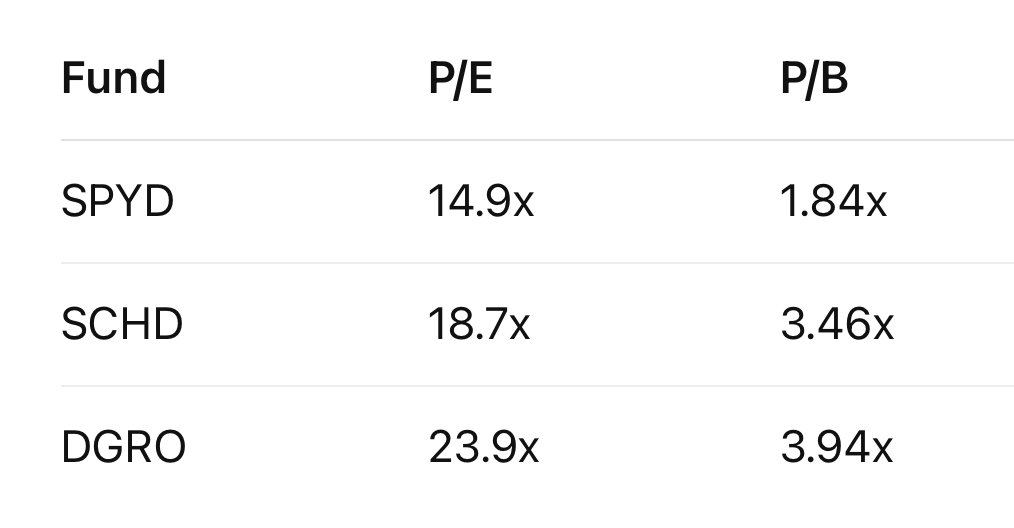
SPYD trades at significantly lower valuation multiples, which could support future upside.
Why SPYD Could Perform Well Going Forward 🗓️
While I do not expect SPYD to outperform SCHD or DGRO over the long term, there are several reasons why the fund could see strong performance in the coming years.
First, the macro environment could become more favorable.
With a new Federal Reserve chair expected to take office, the market is anticipating multiple rate cuts beginning in mid-2026.
Lower rates generally benefit income-oriented assets, as yields on fixed-income investments decline.
This could push investors toward higher-yielding equity funds like SPYD.
Second, SPYD has significant exposure to Consumer Staples and Financials, sectors that could benefit from continued economic expansion and increased AI-driven productivity.
Finally, the ETF’s cheap valuation relative to peers may attract investors looking for value opportunities.
Risks ⚠️
Despite its attractive income profile, SPYD does come with risks.
The largest is its heavy exposure to Real Estate, which could cause underperformance during periods of rising interest rates.
Another issue is tax efficiency.
Due to its REIT exposure, much of SPYD’s distributions are taxed as ordinary income, making the ETF better suited for tax-advantaged accounts like IRAs.
Finally, the fund’s minimal exposure to technology may limit long-term growth relative to other dividend ETFs.
Bottom Line ✅
Despite its shortcomings, SPYD remains an appealing option for income-focused investors.
The ETF offers:
A yield above 4%
Extremely low fees
Exposure to high-dividend S&P 500 companies
While it may continue to trail more growth-oriented dividend funds like SCHD and DGRO, it can still serve as a solid income component within a diversified portfolio.
For investors prioritizing income with the potential for moderate capital appreciation, the SPDR Portfolio S&P 500 High Dividend ETF is worth considering
What ETFs do you hold in your portfolio(s)? Let me know in the comments.
Happy Investing!
☎️ If you’re looking to create passive income and build your wealth from one of the top-rated analysts, book a call (Let’s Talk Investing or Detailed Portfolio Review) with me to get started.
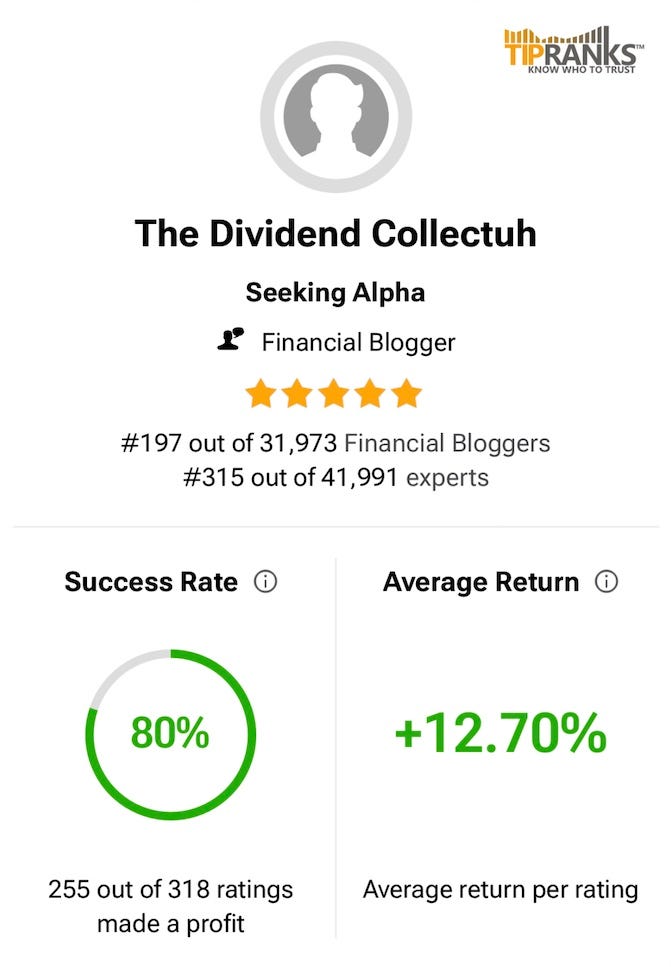
If you’re looking to start investing check out our investment group over on Seeking Alpha.
Here’s How: Click the Seeking Alpha link here. Click investing group, subscribe now, or the blue hyperlink in my bio.
Not financial advice. For educational purposes only. I am not a licensed professional. Do your own due diligence.
Like & subscribe if you’re active duty, a veteran, or just love investing.
High yield ETFs like SPYD are interesting because they expose the trade-off income investors quietly make.
You’re essentially swapping growth exposure for current cash flow.
That works well in certain regimes — especially when rates fall — but over very long periods the opportunity cost of missing the compounding engines inside the index becomes the real question.