

As you know by my name, I love dividends. And in addition to sharing on here, I write regularly on the investment platform- Seeking Alpha.
My goal there is to teach everyday investors about building wealth, so they won’t to need to work to traditional retirement age.
I want to help you take control of your life, have F.I.R.E.
Here at Dividend Collection Agency the goal is to give investors and/or readers a different perspective. We take a simple approach to building wealth. And although investing may seem easy, people often miss opportunities by over complicating it.
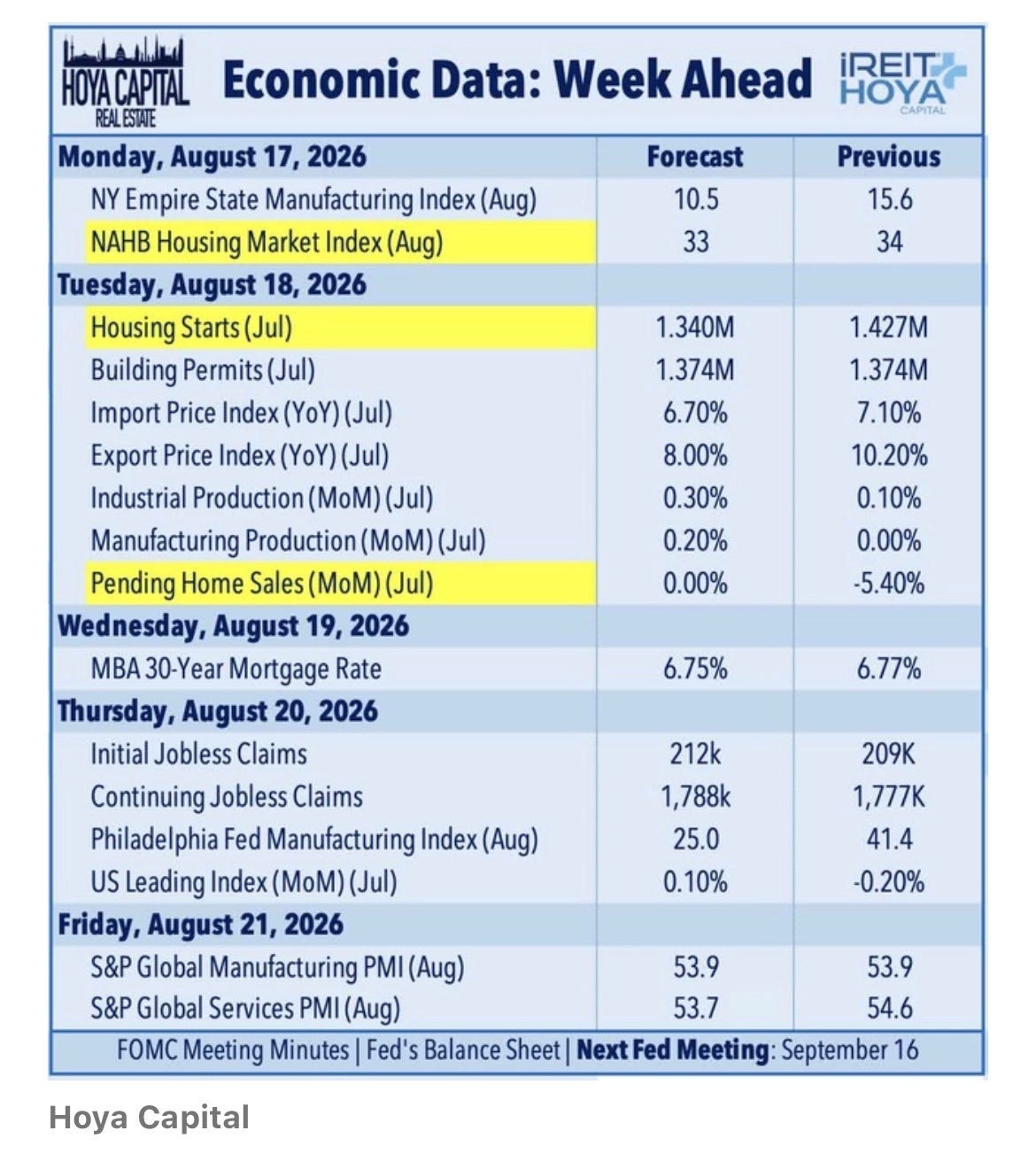
The U.S. housing market takes center stage this week, with several key reports offering investors a fresh look at how elevated mortgage rates are affecting homebuilders, construction activity, and buyer demand.
With mortgage rates hovering near 6.75%, housing affordability remains a major challenge. At the same time, investors will be watching employment data, business activity, inflation pressures, and the Federal Reserve for clues about the direction of monetary policy heading into September.
🏠 Housing Market in Focus
The week kicks off Monday with the NAHB Homebuilder Sentiment Index, which is expected to decline slightly to 33 from 34.
A reading at this level would keep builder confidence deeply depressed as elevated borrowing costs continue to weigh on affordability and demand.
Tuesday brings an even broader look at housing conditions:
Housing Starts: Expected to fall to 1.340 million annualized from 1.427 million
Building Permits: Expected to remain steady at 1.374 million
Pending Home Sales: Expected to be flat in July after falling 5.4% in June
Together, these reports should provide a clearer picture of both the supply and demand sides of the housing market.
Weakness in starts and pending sales would reinforce the view that higher mortgage rates are continuing to restrict activity. On the other hand, stronger-than-expected data could suggest the housing market is proving more resilient than anticipated.
🏭 Business Activity & Inflation Pressures
Friday brings preliminary August S&P Global PMI data, providing an early look at economic activity during the month.
Expectations currently call for:
Manufacturing PMI: 53.9, unchanged from July
Services PMI: 53.7, down from 54.6
Both readings would remain above the 50 level that separates expansion from contraction, suggesting the economy continues to grow despite tighter financial conditions.
Regional manufacturing surveys earlier in the week are also expected to soften from their elevated July readings.
Investors should also pay attention to trade-price data, particularly for signs that higher energy costs are beginning to pass through into goods inflation. Renewed inflation pressure could complicate the Federal Reserve’s policy outlook.
👷 Labor Market Remains Important
Employment will remain another major piece of the economic puzzle.
On Tuesday, investors will get ADP’s weekly Employment Change report, followed by weekly Jobless Claims on Thursday.
Labor-market resilience remains particularly important for the Fed. A gradual cooling in employment could reduce inflationary pressure without signaling a sharp economic downturn, while unexpected deterioration could raise concerns about broader economic weakness.
🏦 The Federal Reserve
Investors will also parse the latest FOMC Minutes for additional insight into how policymakers are thinking about inflation, employment, and interest rates.
Weekly Federal Reserve balance-sheet data will also be released as markets begin looking ahead to the September 16 Fed meeting.
With housing affordability under pressure and several economic indicators showing signs of moderation, the question is whether incoming data will give policymakers greater confidence that inflation is moving in the right direction—or reinforce the case for keeping monetary policy restrictive.
For me, housing will be the biggest story of the week.
Mortgage rates near 6.75% continue to put pressure on affordability, and weakness across builder sentiment, housing starts, and pending sales could signal that restrictive monetary policy is increasingly weighing on one of the most interest-rate-sensitive parts of the economy.
At the same time, the PMI and employment reports will help determine whether that weakness is largely isolated to housing or beginning to spread more broadly.
Heading toward the September Fed meeting, the market will likely remain highly sensitive to any data that changes expectations for inflation, economic growth, and the future path of interest rates.
✅ Bottom Line
Housing is under pressure, but the broader economy continues to expand. This week’s data should help investors determine whether that divergence can continue—or whether higher-for-longer interest rates are finally beginning to have a larger impact on economic growth.
How do you think this week’s reports will affect the market?
Let me know what you think in the comments.
💰 Happy Investing 💰
☎️ If you’re looking to create passive income and build your wealth from one of the top-rated analysts, book a call (Let’s Talk Investing or Detailed Portfolio Review) with me to get started.

If you’re looking to start investing check out our investment group over on Seeking Alpha.
Here’s How: Click the Seeking Alpha link here. Click investing group, subscribe now (GET AN INVESTING GROUP FREE TRIAL), or the blue hyperlink in my bio.
Not financial advice. For educational purposes only. I am not a licensed professional. Do your own due diligence.
Like & subscribe if you’re active duty, a veteran, or just love investing.