
Rising Inflation Makes This Even More Appealing Than Higher Yielding Peers
"Solid 2.9% Dividend Yield That Offers Downside Protection"

As you know by my name, I love dividends. And in addition to sharing on here, I write regularly on the investment platform- Seeking Alpha.
My goal there is to teach everyday investors about building wealth, so they won’t to need to work to traditional retirement age.
I want to help you take control of your life, have F.I.R.E.
Here at Dividend Collection Agency the goal is to give investors and/or readers a different perspective. We take a simple approach to building wealth. And although investing may seem easy, people often miss opportunities by over complicating it.
But we are here to help.
Current Price: $27.68
Exchange-traded funds have become increasingly popular with investors over the past decade — and for good reason.
For many investors, ETFs remove much of the guesswork from investing. Simply buying a quality fund consistently and holding it long term can be one of the easiest ways to build wealth over time.
Personally, I still prefer owning individual companies.
I enjoy analyzing financials, studying valuations, and attempting to identify businesses the market may be undervaluing.
Individual stocks also offer greater upside potential, particularly when quality companies fall out of favor and begin trading at compressed valuations.
That said, ETFs can outperform as well.
Investors with heavy exposure to Technology (XLK) or Energy (XLE) have likely outperformed significantly in recent years.
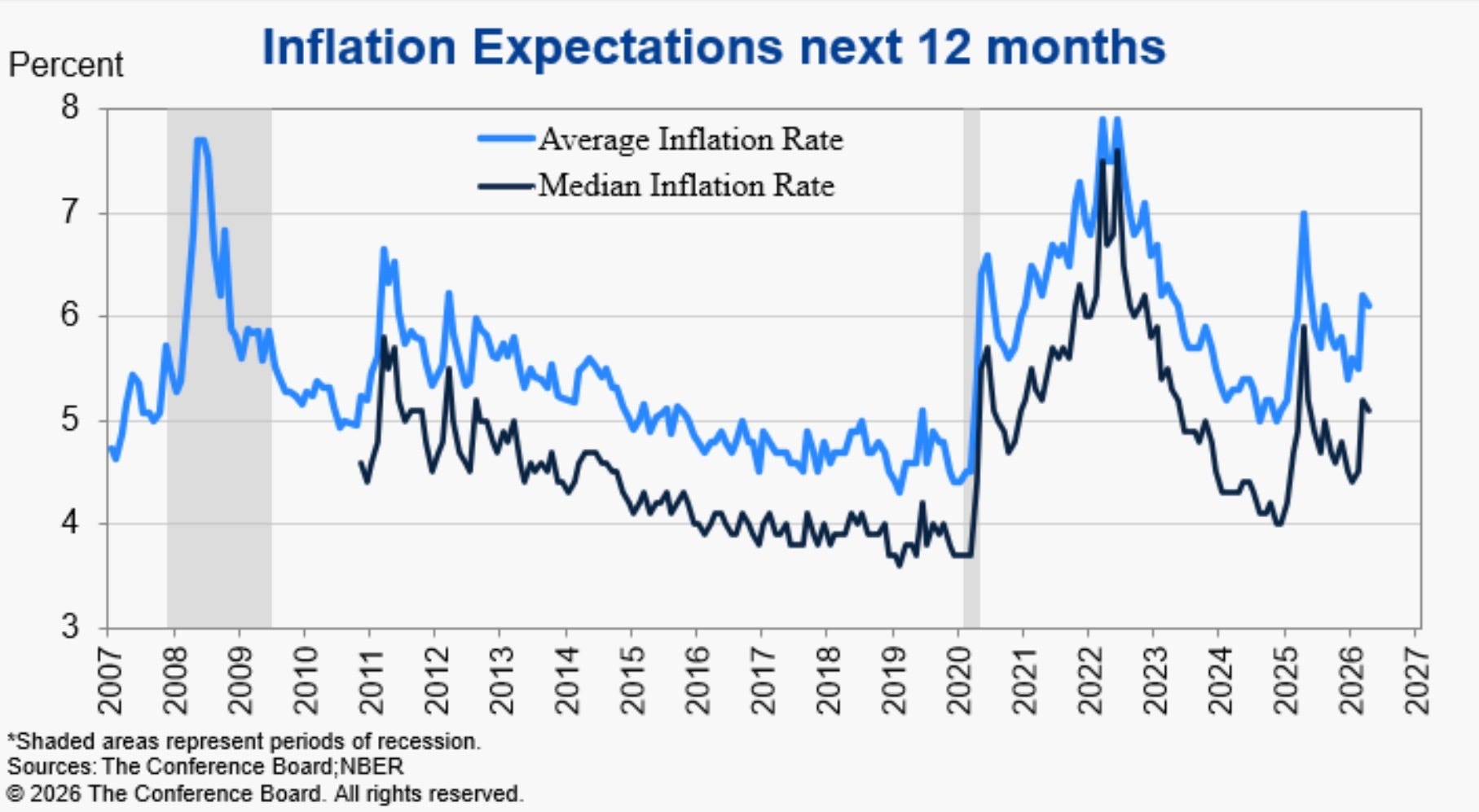
But with inflation beginning to reaccelerate and geopolitical uncertainty continuing to rise, I believe defensive positioning may become increasingly important moving forward.
And that brings me to the iShares Core High Dividend ETF (HDV).
In today’s environment, I think the iShares Core High Dividend ETF may be one of the more attractive defensive income ETFs investors should consider right now.
In this article, I discuss:
HDV’s portfolio structure
Why the ETF may hold up well during volatility
Its long-term performance
And which types of investors may benefit most from owning it
Defensive ETF Built Around Quality 🪖
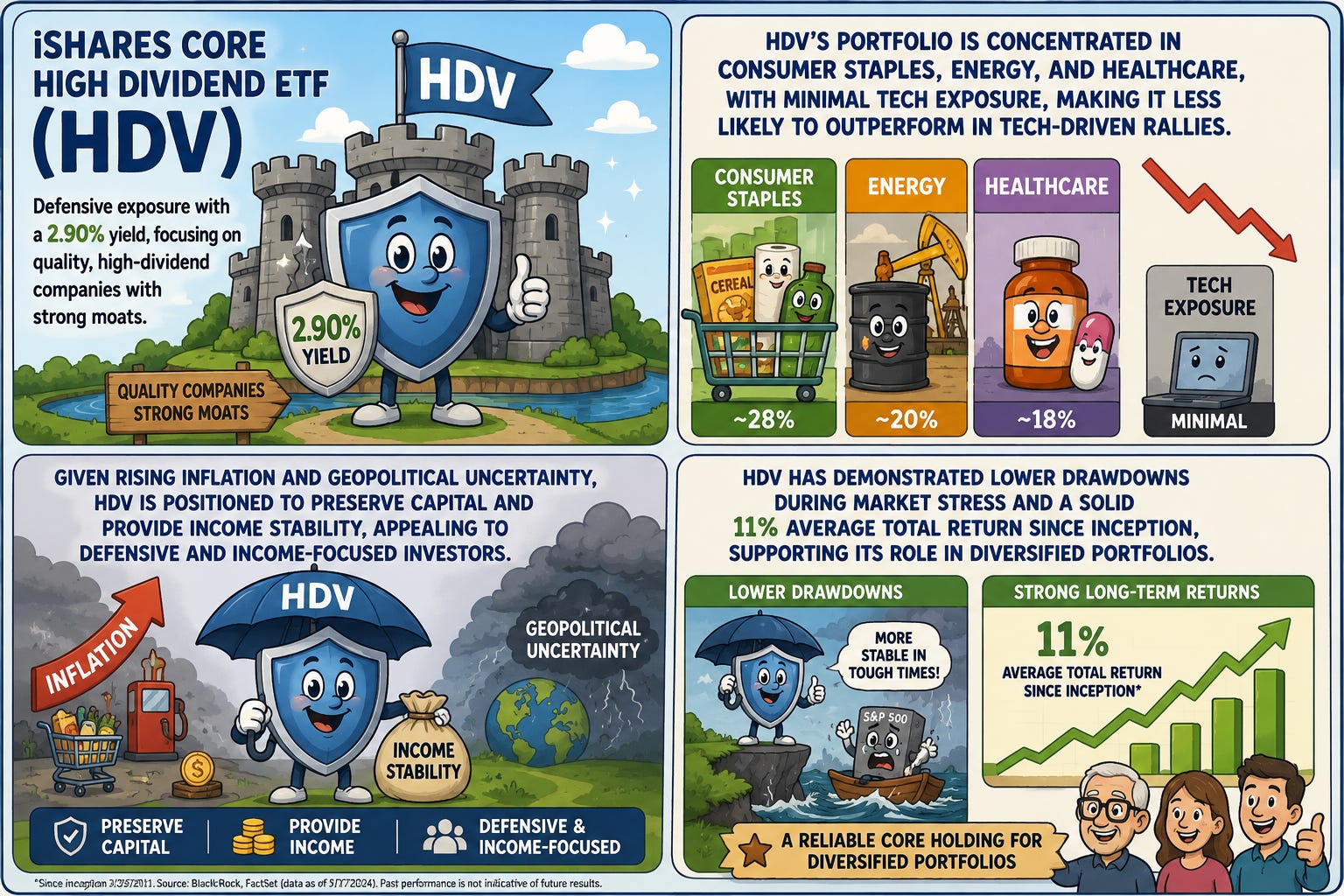
HDV is one of BlackRock’s (BLK) older and more established dividend-focused ETFs, launching back in March of 2011.
Managed by BlackRock, HDV is often viewed as the sister fund to the more popular iShares Core Dividend Growth ETF (DGRO).
The ETF tracks the Morningstar Dividend Yield Focus Index (MDYFT) and primarily invests in companies with above-average dividend yields, durable competitive advantages, and strong financial health.
Currently, HDV yields approximately 2.90%, nearly triple the dividend yield of the broader S&P 500 (SP500).
While some investors may dismiss that yield because it currently sits below inflation, I think that misses the bigger picture.
HDV is not designed to be a high-yield ETF.
It’s designed to be a defensive, quality-focused income ETF capable of preserving capital during difficult market environments.
And that distinction matters.
Unlike some dividend funds that chase yield at the expense of quality, HDV focuses heavily on mature blue-chip businesses with strong cash flows, wide moats, and recession-resistant business models.
Some of its largest holdings include:
The Coca-Cola Company (KO)
The Procter & Gamble Company (PG)
Johnson & Johnson (JNJ)
Texas Instruments (TXN)
Exxon Mobil (XOM)
Chevron (CVX)
AbbVie (ABBV)
The portfolio also includes Dividend Kings and long-term dividend growers like:
Altria (MO)
PepsiCo (PEP)
Colgate-Palmolive (CL)
Sector Exposure Matters 📊
One of the biggest reasons HDV stands out right now is its sector positioning.
Consumer Staples (XLP) is currently the ETF’s largest allocation, followed by Energy and Healthcare (XLV).
Technology exposure, meanwhile, sits around just 8%.
Under normal circumstances, that would likely be viewed negatively.
And honestly, it probably will limit upside during aggressive AI-driven rallies.
If artificial intelligence continues dominating market leadership, ETFs with significantly higher tech exposure will likely outperform HDV over time.
But that’s not really the purpose of this fund.
HDV is not built to aggressively outperform during euphoric bull markets.
It’s built to remain resilient during periods of:
Rising inflation
Elevated bond yields
Economic uncertainty
Geopolitical instability
Market volatility
And right now, we’re experiencing all five.
Why HDV May Be Appealing Right Now 🤩
Inflation recently reaccelerated to 3.8%, reigniting fears that inflation may remain higher for longer than investors initially expected.
At the same time, geopolitical tensions involving Iran continue adding uncertainty to global markets, particularly energy markets.
Oil prices have risen sharply in recent months, increasing concerns that inflationary pressures could intensify once again.
If inflation remains elevated, Treasury yields could continue climbing, which would likely pressure equity valuations and increase volatility across the broader market.
That environment tends to favor:
defensive sectors,
cash-generating businesses,
and lower-volatility portfolios.
Which is exactly where HDV fits in.
Another factor worth noting is the ETF’s downside resilience.
During last year’s sharp “Liberation Day” selloff, HDV experienced a smaller drawdown than several popular dividend ETF peers.
For example:
Schwab U.S. Dividend Equity ETF (SCHD) fell roughly 10.5%
HDV declined less than 9%
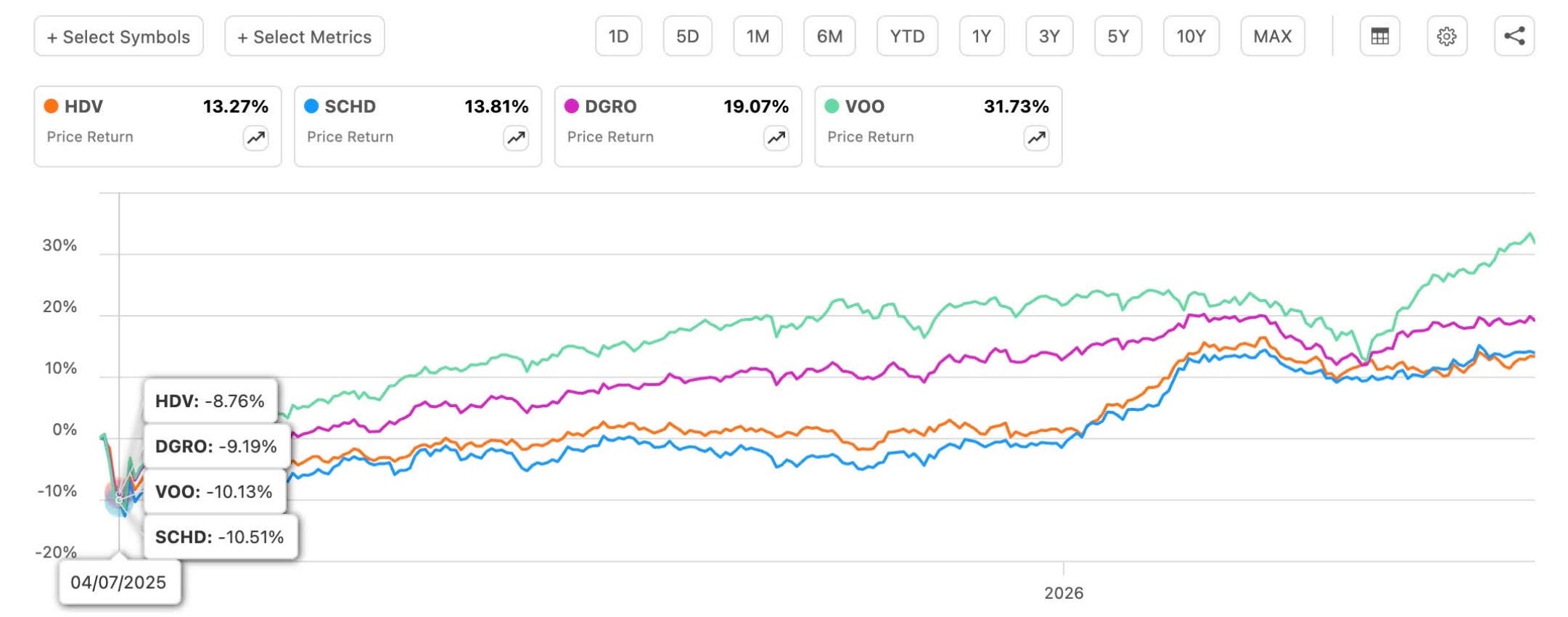
That may not sound like a massive difference on paper, but smaller drawdowns can have a meaningful impact on long-term compounding and investor psychology.
Long-Term Performance Has Still Been Strong 💪🏾
Despite its defensive structure, HDV’s long-term returns have still been respectable.
Since inception, the ETF has generated annualized total returns close to 11%, while also providing qualified quarterly dividend income.
A hypothetical $10,000 investment at inception would now be worth roughly $46,000.
No, HDV has not been the top-performing dividend ETF over the last decade.
Funds like DGRO have outperformed thanks to heavier exposure to Technology and growth-oriented sectors.
But again, that comes back to understanding what HDV is designed to accomplish.
This is not a high-growth ETF.
It’s a quality-focused defensive income fund designed to:
reduce volatility,
preserve capital,
and generate reliable income over time.
Who Should Own HDV? 🤷🏾♂️
In my opinion, HDV may be most attractive for investors who:
already have substantial growth exposure,
want additional defensive positioning,
prioritize income stability,
or are becoming increasingly concerned about macroeconomic risks.
I also think the fund makes sense for:
retirees,
conservative investors,
income-focused portfolios,
and investors seeking lower portfolio volatility.
One thing I personally like about HDV is its relatively concentrated structure.
The ETF holds only around 74 equities, allowing management to maintain meaningful exposure to its highest-conviction holdings instead of becoming overly diluted across hundreds of positions.
That concentration helps HDV feel more intentional compared to broader dividend funds.
Bottom Line ✅
The iShares Core High Dividend ETF appears increasingly attractive as inflation concerns and geopolitical uncertainty continue rising.
While the ETF will likely lag during aggressive technology-led rallies, I believe its defensive structure could allow it to outperform in a more volatile or risk-off market environment.
Going forward, I suspect investors may increasingly prioritize:
capital preservation,
reliable income,
lower volatility,
and defensive positioning.
And if that happens, HDV could become one of the more appealing dividend ETFs to own moving into 2026 and beyond.
For investors seeking stability rather than maximum upside, HDV may deserve a closer look.
How do you think HDV will do in the coming months if inflation worries continue? Let me know in the comments.
Just a note to let readers know I will be going paid soon. Be on the lookout for the article laying out the details. Feel free to provide any feedback!
Happy Investing!
☎️ If you’re looking to create passive income and build your wealth from one of the top-rated analysts, book a call (Let’s Talk Investing or Detailed Portfolio Review) with me to get started.
If you’re looking to start investing check out our investment group over on Seeking Alpha.
Here’s How: Click the Seeking Alpha link here. Click investing group, subscribe now (GET AN INVESTING GROUP FREE TRIAL), or the blue hyperlink in my bio.
Not financial advice. For educational purposes only. I am not a licensed professional. Do your own due diligence.
Like & subscribe if you’re active duty, a veteran, or just love investing.