
This 13% Yielding BDC Could Be At Risk
"Discount & Yield Attractive, But Is The Market Seeing Something You're Not?"

As you know by my name, I love dividends. And in addition to sharing on here, I write regularly on the investment platform- Seeking Alpha.
My goal there is to teach everyday investors about building wealth, so they won’t to need to work to traditional retirement age.
I want to help you take control of your life, have F.I.R.E.
Here at Dividend Collection Agency the goal is to give investors and/or readers a different perspective. We take a simple approach to building wealth. And although investing may seem easy, people often miss opportunities by over complicating it.
But we are here to help.
Current Price: $24.31
Yield: 12.73%
Portfolio Purpose: Income 💰
Business Development Companies (BDCs) remain one of my favorite asset classes. As an income-focused investor, I was initially drawn to them years ago when looking for ways to use dividends to supplement my retirement.
While I still believe BDCs are often overlooked as long-term income investments, they’ve grown exponentially in popularity among income investors and contributors on Seeking Alpha. However, due to their interest-rate sensitivity and the possibility of sector headwinds in 2026, I’ve turned more cautious on the space over the past year.
When it comes to Blackstone Secured Lending Fund (BXSL), I still consider them one of the highest-quality BDCs in the sector. However, despite the company’s strengths, I believe there is a real possibility of a dividend reduction sometime this year, which could lead to continued underperformance.
In this article, I discuss BXSL’s latest quarter, the risks investors should be watching, and why I remain cautious heading into 2026.
Previous Hold Thesis ✋🏾
I last covered BXSL following their Q3 earnings on Seeking Alpha.
During that quarter, the BDC experienced accelerated investment activity, the highest since the fourth quarter of 2024. Deployments increased 90% quarter-over-quarter, surpassing the $1 billion mark.
This increased activity helped boost their net investment income (NII) from $0.77 to $0.82 per share, improving dividend coverage and calming investor concerns.
However, I remained cautious due to:
Macro uncertainty
Expected interest rate cuts
BXSL’s heavy exposure to floating-rate debt
Because of these factors, I warned that dividend pressure could emerge within the next 6–12 months.
Since then, shares have continued to underperform. At the time of writing, BXSL is down roughly 7%, compared to the S&P 500 (SP 500) gaining over 4% during the same period.
A Solid Quarter Overall 📊
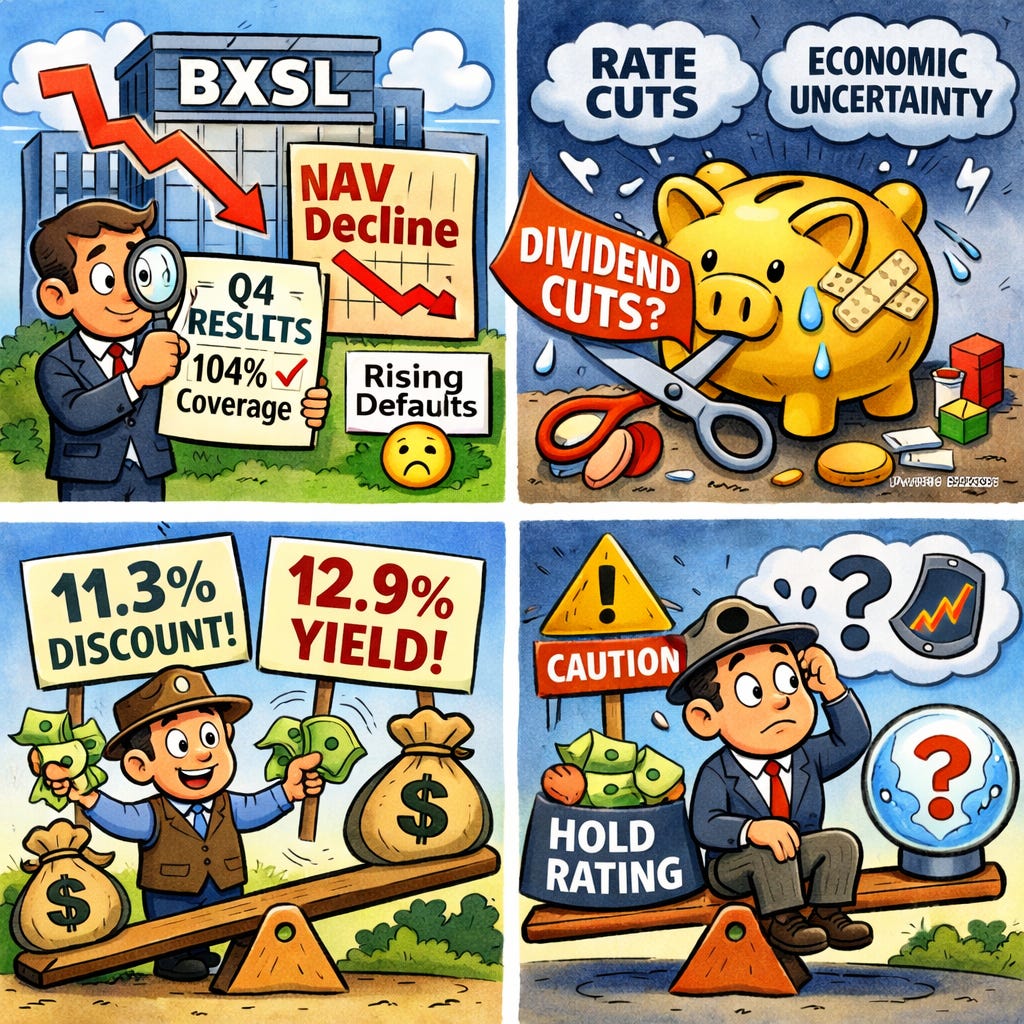
BXSL’s fourth quarter results were decent overall, mainly because the company maintained reasonable dividend coverage.
Net investment income: $0.80 per share
Dividend coverage: 104%
While this level of coverage does not provide significant flexibility, it did improve from 100% coverage earlier in the year. However, coverage declined slightly from 106% in the prior quarter due to a small drop in NII.
Year-over-year results were somewhat mixed:
NII per share: declined from $0.84 to $0.80
Total NII dollars: increased 2% from $183M to $186M
Total investment income: rose to $358M, up $5M YoY but slightly missing analyst estimates
Investment activity also remained strong.
During Q4:
Fundings increased from $1.007B to $1.042B
Commitments declined from $1.3B to $907M
Repayments increased from $433M to $537M
The company also added 13 new borrowers, bringing the total to 316 portfolio companies, compared to 276 the prior year.
As a result, BXSL’s portfolio value increased to $14.2 billion.
Management also expects $550 million in loan repayments during the first half of the year, which should support continued portfolio activity.
Overall, it was not a spectacular quarter, but still solid.
What Concerned Me 🤔
Despite the decent operating performance, there were several developments that raised concerns.
NAV Decline:
BXSL reported $0.27 in unrealized losses, which contributed to a decline in net asset value.
Their NAV declined sequentially by $0.23, ending the quarter at $26.92.
Short-term NAV volatility is normal for BDCs, but I prefer to see consistent long-term NAV growth in higher-quality companies.
For comparison, several top BDC peers performed better:
Ares Capital (ARCC)
NAV grew slightly from $19.89 to $19.94
Capital Southwest (CSWC)
NAV increased 0.96% to $16.75
Hercules Capital (HTGC)
NAV rose 4% year-over-year to $12.13
While BXSL’s decline is not alarming by itself, sequential NAV declines are something investors should monitor closely.
One positive development was management’s announcement of a $250 million share buyback program, which could help support NAV over time.
Credit Quality Concerns 🏦
Another area worth watching is credit quality trends.
Non-accruals increased to:
0.6% at cost
0.5% at fair value
This compares to just 0.1% in the prior quarter.
While these levels are still relatively low, the increase is notable and could indicate rising stress among borrowers.
Similarly, payment-in-kind (PIK) income rose from 8.2% to 8.6%.
Some PIK income is normal in BDC structures, but increases can sometimes signal borrower financial strain.
Software Exposure Adds Risk ⚠️
Another risk factor is BXSL’s significant exposure to software companies, which have recently faced volatility due to rapid AI disruption.
Management addressed this concern during the earnings call, noting that their investments are concentrated in defensive software sub-sectors, including:
Vertical software
ERP platforms
Data infrastructure
Data management
Cybersecurity
According to management, these companies generate:
Over 2x interest coverage
Approximately 40% EBITDA growth
While these metrics are encouraging, software companies could still experience continued volatility, which may lead to higher PIK income and potential credit pressure.
This also puts BXSL at a disadvantage relative to peers like Capital Southwest, which has less than 5% software exposure.
Leverage Is Rising ⚖️
Leverage also increased modestly.
BXSL reported an average leverage ratio of 1.27x, slightly above management’s targeted range of 1.25x.
This compares to:
1.22x in Q3
1.17x one year ago
This places BXSL above the peer average of roughly 1.21x.
While still manageable, the rising leverage trend is something investors should monitor.
On the positive side, liquidity remains strong:
$2.5 billion available liquidity
$8.1 billion total debt
Investment-grade ratings from all three major agencies
BXSL also has $1.5 billion of debt maturing in 2026 at relatively attractive interest rates.
The Valuation Is More Attractive Now 📉
When interest rates were higher in 2023 and 2024, BXSL traded at one of the largest premiums to NAV in the sector.
That is no longer the case.
Shares are now down more than 28% over the past year, pushing valuation to a much more attractive level.
Currently BXSL trades at:
0.89x price-to-NAV
11.3% discount to NAV
12.9% dividend yield
For income investors, this combination of discount and high yield may look appealing.
The Main Risk: Dividend Sustainability 💵
Despite the attractive valuation, my main concern remains dividend sustainability.
With a new Federal Reserve Chair expected in May, I believe we could see multiple interest rate cuts this year.
Lower rates create a difficult environment for BDCs because:
Portfolio yields decline
Net investment income falls
Dividend coverage tightens
Although lower rates can stimulate new investment activity, I don’t believe that will be enough to fully offset declining loan yields.
Another challenge is BXSL’s discount to NAV, which limits the company’s ability to raise capital accretively for new investments.
If dividend coverage tightens further, a dividend reduction becomes increasingly possible.
Should that occur, I believe the share price could fall below $24 per share.
How Investors Should Approach BXSL 🧑🏾💻
For income-focused investors, BXSL’s 12.9% yield and discount to NAV may look compelling.
However, I believe caution is warranted.
If the dividend is reduced, history suggests the market will react negatively, as dividend cuts are rarely fully priced in ahead of time.
For this reason, I believe investors should wait for more clarity during the back half of the year, particularly as interest rate cuts begin to take effect.
What Could Prove Me Wrong 🧐
There are still scenarios where BXSL performs better than expected.
If the company can:
Maintain strong investment activity
Stabilize NAV
Avoid a dividend reduction
Then the current valuation could prove to be a compelling entry point.
In that case, I would likely upgrade my rating to Buy.
Bottom Line ✅
Blackstone Secured Lending remains one of the highest-quality BDCs in the sector, supported by Blackstone’s scale, strong liquidity, and disciplined underwriting.
However, several risks keep me cautious:
Potential interest rate cuts
Rising non-accruals and PIK income
High software exposure
Increasing leverage
While the 11.3% discount to NAV and 12.9% yield are attractive, I believe the risk of a dividend reduction and continued underperformance remains elevated.
For now, due to the lack of near-term catalysts and ongoing macro uncertainty, I maintain my Hold rating on BXSL.
Do you think a dividend cut is on the table in 2026? Let me know in the comments.
Happy Investing!
☎️ If you’re looking to create passive income and build your wealth from one of the top-rated analysts, book a call (Let’s Talk Investing or Detailed Portfolio Review) with me to get started.
If you’re looking to start investing check out our investment group over on Seeking Alpha.
Here’s How: Click the Seeking Alpha link here. Click investing group, subscribe now, or the blue hyperlink in my bio.
Not financial advice. For educational purposes only. I am not a licensed professional. Do your own due diligence.
Like & subscribe if you’re active duty, a veteran, or just love investing.